



Pylon Signs vs Monolith Signs: Which Freestanding Sign Fits Your Site
- October 08th, 2026
When it comes to freestanding signage, the choice between a pylon sign and a monolith sign often comes down to more than just looks. Height, visibility, council rules and how it fits the surrounding streetscape all play a part in deciding which option ultimately works best.
Whether you’re after retail signs, a shop sign for your storefront or a business sign for a growing Melbourne business, getting this decision right can make a big difference in the long run.
In this guide, we break down what sets pylon and monolith signs apart, so you can work out which one suits your property and your brand.
Pylon vs Monolith Signs: Key Differences at a Glance
The most obvious difference between pylon signs and monolith signs involves height and design. Pylon signs are mounted on poles that are visible for a long distance, and monolith signs are mounted on the ground. In high traffic areas pylon signs can be as high as 30 metres, while monolith signs generally won’t be more than 5 metres high.
Pylon signs are great for shopping centres and petrol stations on the highway where you’re trying to get the attention of people in traffic. Monolith signs work well in corporate parks and modern building centres where there is more time to read what is on the sign.
What Are Pylon Signs Best For?
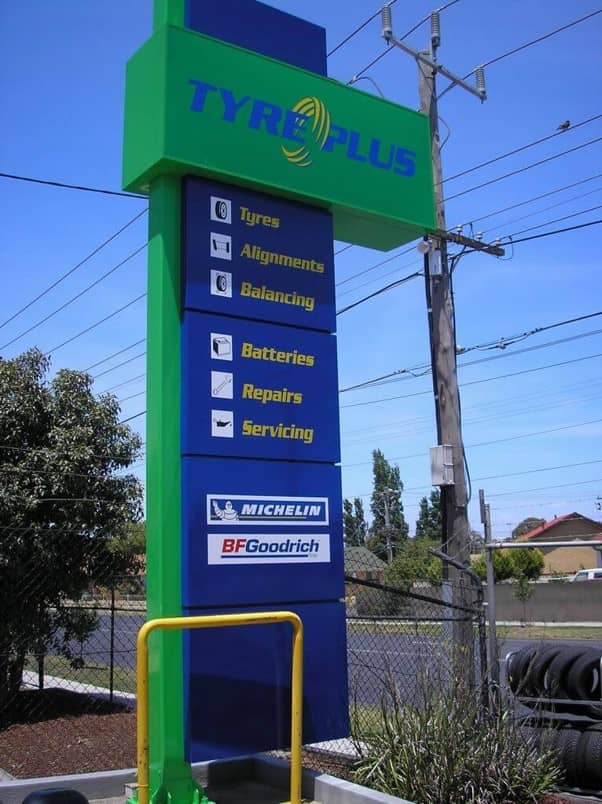
Let’s go into some more detail about pylon signs, what they are and where it’s best to use them. They are tall, freestanding outdoor structures that are best used to maximise long-range visibility of potential customers. You will mainly see them on main roads and highways and commercial corridors. Often, the larger they are, the further away you can discern their message.
Key Features
- Height: These signs usually start around 6 metres tall and can reach much higher near major highways.
- Visibility: They rise above nearby buildings, trees, and vehicles to catch the eye of passing drivers.
- Structure: They use a heavy steel or aluminum frame mounted on a strong concrete foundation. The poles can be left exposed or covered with an architectural cabinet.
- Lighting: Many options include internal LED illumination, external floodlights, or digital message boards.
Best Uses for Pylon Signs
- High-Speed Traffic Areas: They are perfect for businesses near fast-moving highways or major thoroughfares where drivers need advance notice to turn or change lanes safely.
- Obstructed Locations: Perfect for properties set far back from the road, or when landscaping or neighboring buildings block the view of ground-level signage.
- Multi-Tenant Complexes: Excellent for shopping centers and industrial parks that need to display multiple business names or logos on a single elevated structure.
- 24/7 and Nighttime Visibility: Highly effective when equipped with internal LED or digital illumination to attract passing motorists after dark.
- Landmark Identification: Great for service-oriented businesses like petrol stations, hotels, fast-food restaurants, and car dealerships that rely on being spotted from a great distance.
What Are Monolith Signs Best For?
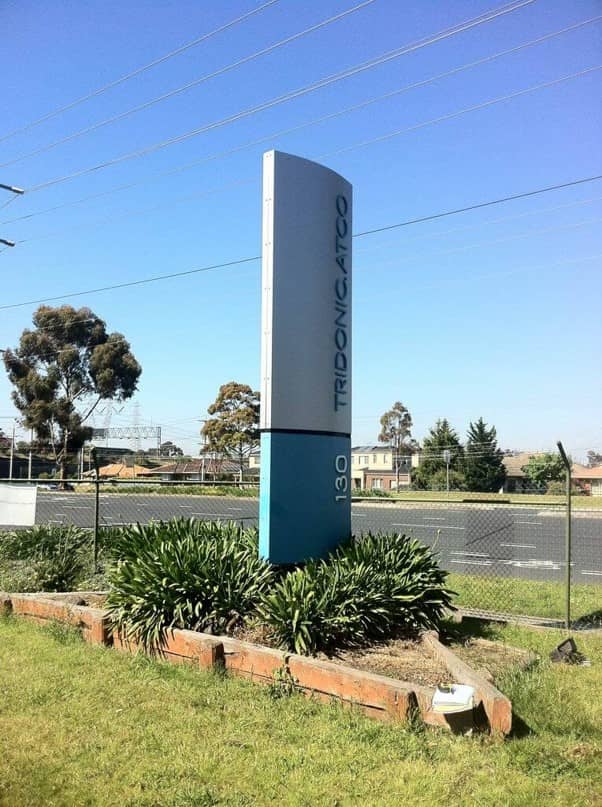
Monolith signs, as well as having an impressive name, are freestanding and self-supporting outdoor structures that display business branding or directions. They are not as tall as a pylon sign and do not have a pole-like structure to them. Their internal supports are completely enclosed with a seamless outer cladding that runs all the way to the ground.
Key Features
- Concealed Structure: Internal steel or aluminum frames are fully wrapped and clad, hiding all bolts and supports for a sophisticated look.
- High Visibility: Positioned independently near road junctions, car parks, or main entry points to catch the eye of drivers and pedestrians.
- Custom Shapes & Lighting: Available in single-sided, multi-sided, or curved designs, and frequently enhanced with internal LED or halo-lit illumination.
- Durability: Built from robust materials like aluminum, steel, brick, or stone to withstand harsh weather conditions with minimal upkeep.
Best Applications
- Site Entrances: Marking property lines, driveways, or turnoffs from main roads so drivers can spot the location from a distance.
- Multi-Tenant or Large Complexes: Directing visitors around business parks, shopping centres, hospitals, schools, and industrial estates.
- Standalone Prestige Branding: Showcasing a single company logo or car showroom with a sleek, permanent architectural look.
Visibility and Sightlines: Which Sign Gets Noticed?
Choosing the right sign depends on how fast your audience is moving and how far away they are.
| Sign Type | Best For | Typical Placement | Visual Advantage |
| Pylon Signs | Highway traffic & long-range viewing | Tall poles near freeways | Towers over obstructions to catch high-speed drivers early. |
| Monument Signs | Street-level traffic & pedestrians | Eye-level at property entrances | Creates a premium, permanent branding presence at close range. |
Key Factors That Determine “Noticeability”
- The Angle of Incidence: Drivers rarely look sideways; they look forward. Signs placed perpendicular to the road get noticed significantly faster than signs mounted flat against a building parallel to the road.
- Luminance and Contrast: An illuminated sign gets noticed up to 70% more at night than a non-illuminated one. High contrast between the text and the background is critical for quick reading.
- Letter Height and Speed: As a rule of thumb, you need 3cm of letter height for every 3 metres of viewing distance. If drivers are travelling at 80km/h, they need at least 130 metres of readability to safely process the message and turn.
Sign Height, Size and Council Permit Requirements
You generally need a building or planning permit for any sign over 1 metre high near a street boundary, larger than 8 square metres in commercial zones, or exceeding 0.7 square metres in residential areas.
The rules depend heavily on your local municipality (such as Knox City Council for the Boronia area) and specific property zoning. Verify local constraints using the VicPlan mapping tool or contact your local council.
General Permit Requirements
- Building Permits: Usually needed if a sign is taller than 1 metre and within 3 metres of the street boundary, stands higher than 8 metres above ground level, or exceeds a 6 square metre display area.
- Planning Permits: These are generally required for commercial signs over 8m², residential signs over 0.7m², any illuminated or electronic flashing displays, and pylon or pole structures.
- Exemptions: Small signs under 0.2m² (A4 size), temporary real estate boards, or certain business identification signs under specific size limits in industrial or commercial zones may be exempt if they meet strict criteria.
Which Costs More to Install and Maintain?
Pylon signs cost more to install and maintain than monolith signs. Pylons are taller, freestanding structures that need multiple poles to support them, or have enclosed steel columns.
Monolith signs are lower profile, closer to the ground so don’t need as much reinforcement to support them against the elements.
Pylon signs have a higher maintenance cost as well. The height makes routing cleaning more difficult, as well as changing light bulbs or LEDs. You need people licensed to drive scissor lifts or cherry pickers to get that high. And being that tall, pylon signs are more susceptible to shear winds and bad weather.
The low profile of a monolith sign makes it easier to clean and maintain, and also protects them from the more severe elements of the weather.
A Quick-Look Comparison Table
We’ve pulled all of the information into this easy-to-read table for you to compare, side-by-side.
Swift Signs — Pylon vs Monolith Fact Sheet
| Pylon | Monolith | |
| Structure | Exposed poles/columns | Fully clad, enclosed base |
| Height | 6m–30m+ | 1.5m–3.5m |
| Sightline | High-speed traffic, long-range | Pedestrian/slow traffic, close-range |
| Best for | Highway frontage, petrol stations, multi-tenant shopping centres, sites set back from road | Boutique retail, corporate/medical precincts, entrance markers |
| Install cost* | $18,000–$45,000 (mid-size illuminated); $45,000–$120,000+ for large multi-tenant/highway | $6,000–$18,000 |
| Why costlier | Deep footings, steel framing, crane/engineering | Shallow slab, basic site prep |
| Maintenance | Elevated access needed (bucket truck/crane) | Ground-level, easy access |
| Weather/wind | More exposed to wind shear, higher structural stress | Lower profile, better wind/rain resistance |
| Melbourne permits | Generally triggers planning permit (pole structures) | May still need permit if >1m near boundary or >8m² |
*Figures gathered from industry sources around the web — actual cost depends on site, wind region, and council requirements. For a real price, get a free quote from Swift Signs.
Extra detail worth using: letter height rule — approx. 25mm of letter height for every 3 metres of viewing distance.
Get a Free Quote for Your Freestanding Sign
Choosing between a pylon and a monolith sign really comes down to your site, your audience and how fast they’re moving past it. If you’re on a busy road or highway and need to be seen from a distance, a pylon sign does the heavy lifting. If your site sees more foot traffic or you want a sleek, architectural presence at eye level, a monolith is the better fit.
Either way, council permits, wind engineering and site conditions all affect the final build and cost, so the fact sheet above is a starting point, not a final number. The team at Swift Signs can assess your site and talk you through the right option for your budget and location. Get in touch for a free quote.